
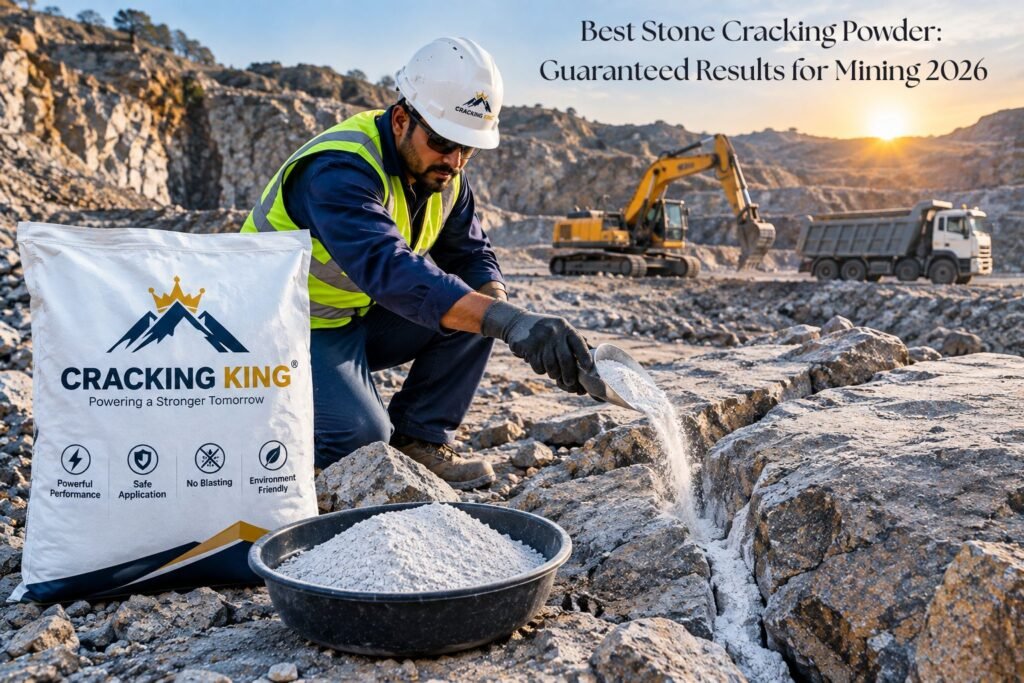
Mining and quarrying operations across India are shifting away from noisy, dangerous explosives toward a safer, smarter alternative. The Best Stone Cracking Powder has become the go-to solution for contractors, miners, and demolition experts who want guaranteed rock-breaking results without the risks that come with traditional blasting. Whether you are working on granite quarries, limestone mines, or large-scale demolition projects, this expansive mortar-based technology is changing the way rock is broken in 2026.
In this guide, we will walk you through everything you need to know about this powerful mining solution, from how it works to correct usage, pricing, and safety.
What Is Stone Cracking Powder and How Does It Work?
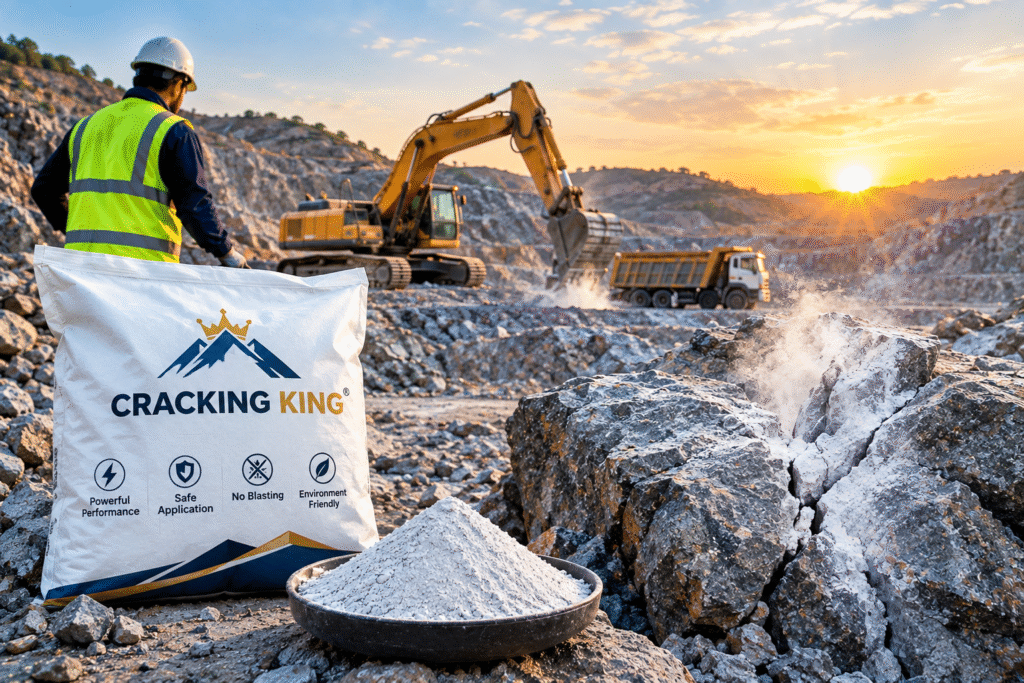
This non-explosive, expansive demineral compound breaks rock, concrete, and stone through controlled expansion pressure rather than combustion. When mixed with water and poured into pre-drilled holes, the powder undergoes a chemical hydration reaction that causes it to expand significantly within a few hours. This expansion generates enormous internal pressure inside the rock, cracking it cleanly along the drilled hole line without any explosion, fire, or shockwave.
Unlike dynamite or gunpowder-based blasting agents, this product relies purely on physical expansion force. The reaction is slow and controlled, which is exactly why it is favored in environments where safety and precision matter more than speed.
Key points about how it works:
- Made from a blend of calcium oxide and specialised minerals
- Expands up to several times its original volume when hydrated
- Generates pressure exceeding 8,000 to 10,000 psi inside the rock
- Cracking typically begins within 2 to 24 hours depending on rock type and temperature
- Leaves no explosive residue, smoke, or toxic fumes behind
Why the Best Stone Cracking Powder Beats Traditional Blasting
Traditional blasting with dynamite or ANFO explosives has long been the standard in mining, but it comes with serious downsides: licensing hurdles, safety risks, community complaints, and unpredictable rock fragmentation. This is precisely where expansive powder proves its worth as a superior alternative.
With this method, mining companies get predictable, controlled results every single time. There is no need for explosive licenses in many regions, no blast zones to evacuate, and no risk of misfires or unexploded charges lying hidden in rubble.
Benefits over traditional blasting:
- No explosives license or government permit required in most areas
- Zero risk of accidental detonation or misfire
- Predictable, uniform rock fragmentation
- Lower long-term operational costs
- Reduced insurance and liability concerns
- Works in restricted zones near residential areas, pipelines, or heritage structures
No Noise, No Vibration, No Flying Debris
One of the biggest advantages that sets this method apart is the complete absence of noise, vibration, and debris scatter. Conventional blasting sends shockwaves through the ground that can damage nearby structures, disturb wildlife, and generate loud noise pollution that draws complaints from surrounding communities.
Since the cracking process happens gradually through internal pressure rather than a sudden explosion, there is no bang, no ground vibration, and no rock fragments flying through the air. This makes it ideal for sensitive locations such as urban demolition sites, areas near schools or hospitals, and mining zones close to residential colonies.
Advantages of silent operation:
- Safe for use near buildings, roads, and utility lines
- No compliance issues related to noise pollution norms
- No need for blast mats or protective barriers
- Reduces risk of structural damage to nearby property
- Improves worker safety by eliminating flying rock hazards
Soundless Stone Cracking Powder for Mining Operations
Mining operations that deal with granite, marble, limestone, and sandstone extraction have increasingly adopted this soundless method as their primary rock-breaking technique. This is especially true in quarries located near populated areas or in regions where blasting permits are difficult to obtain.
The powder works exceptionally well on hard rock formations because it can be applied in a controlled grid pattern across large surface areas, allowing miners to extract stone blocks in predictable shapes and sizes. This is a major benefit for the natural stone industry, where block integrity directly affects market value.
Common mining applications:
- Granite and marble block extraction for the natural stone industry
- Limestone quarrying for cement and construction material
- Sandstone mining for architectural and decorative use
- Secondary rock breaking after primary blasting operations
- Boulder splitting in open-pit mining sites
How to Use Stone Cracking Powder: Step-by-Step Guide
Using this stone cracking powder correctly is essential to achieving guaranteed results. The process is straightforward, but precision in drilling and mixing makes all the difference between a clean crack and a failed application.
Step-by-step process:
- Identify the rock type and select the correct powder grade
- Drill holes of the recommended diameter (typically 32mm to 50mm) at calculated spacing
- Clean out drill dust from each hole using compressed air
- Mix the powder with clean water in the correct ratio until it forms a smooth slurry
- Pour the mixture into each hole immediately, filling to about 90 percent capacity
- Leave the site undisturbed and allow the reaction to develop over several hours
- Inspect for visible cracks and proceed with mechanical separation if needed
Correct Hole Spacing and Drilling Pattern
Hole spacing is arguably the most critical factor in determining whether the cracking process succeeds. Holes placed too far apart will fail to connect the cracks, while holes placed too close together waste material without improving results.
As a general guideline, hole spacing should be roughly 8 to 10 times the hole diameter, though this varies based on rock hardness and the presence of natural fracture lines. Softer rocks like limestone allow for wider spacing, while dense granite requires tighter patterns.
Drilling pattern guidelines:
- Space holes 300 mm to 600 mm apart depending on rock density
- Drill hole depth to at least 80 per cent of the rock thickness
- Align holes in a straight line for directional cracking
- Avoid drilling near existing fractures or weak seams
- Adjust spacing tighter for reinforced concrete or extremely hard rock
Water-to-Powder Mixing Ratio
Getting the mixing ratio right directly affects how well the powder expands and how quickly the reaction begins. Too much water weakens the expansion force, while too little water prevents the powder from flowing properly into the drilled holes.
The standard ratio recommended by most manufacturers is around 25 to 28 percent water by weight of powder, though this can shift slightly based on ambient temperature. Always use clean, cool water for the best results, and mix only the quantity you can pour within a few minutes, since the slurry begins reacting almost immediately.
Mixing tips:
- Use a mechanical mixer for consistent slurry texture
- Mix in small batches to avoid premature setting
- Avoid using warm water, as it accelerates the reaction too quickly
- Pour within 3 to 5 minutes of mixing for best expansion
- Wear gloves and eye protection while handling wet slurry
Choosing the Right Temperature Grade (Summer vs Winter)
Temperature has a major impact on how fast the powder reacts, which is why manufacturers produce different grades suited to different seasons. Using the wrong grade in extreme weather can lead to cracking that happens too fast, too slow, or not at all.
Summer grade powder is formulated to react more slowly, compensating for the accelerating effect of high ambient temperatures. Winter-grade powder, on the other hand, is designed to generate heat faster to overcome the slowing effect of cold weather on the chemical reaction.
Grade selection guide:
- Summer grade: recommended for temperatures above 30°C
- Winter grade: recommended for temperatures below 15°C
- Standard grade: suitable for moderate 15°C to 30°C conditions
- Store powder in a dry, sealed container regardless of grade
- Never mix summer and winter grades together in the same batch
Stone Cracking Powder Price in India: Cost Per Kg
Pricing for this product in India varies based on quantity ordered, brand quality, and the specific grade required for your climate and rock type. Bulk buyers such as mining companies and quarry contractors typically receive significant discounts compared to small retail purchases.
On average, quality-grade powder falls within a moderate per-kilogram price range, with costs decreasing as order volume increases. Buyers should always request a sample batch before committing to a large bulk order, ensuring the product performs well on their specific rock type.
Pricing considerations:
- Retail pricing is higher per kg compared to bulk industrial orders
- Bulk mining contracts often qualify for wholesale rates
- Price varies slightly between summer, winter, and standard grades
- Transport and packaging costs may add to the final price for remote sites
- Always compare price against consumption rate per cubic meter, not just per kg
Safety Guidelines and Handling Precautions
While this method is far safer than explosive blasting, proper handling is still essential to avoid skin irritation, eye contact, or inhalation of fine powder dust during mixing.
Safety guidelines:
- Wear rubber gloves, safety goggles, and a dust mask while handling powder
- Avoid direct skin contact with the wet slurry, as it is highly alkaline
- Store powder bags in a cool, dry place away from moisture
- Keep unused powder sealed tightly to prevent premature hydration
- Never stand directly over a filled hole during the expansion period
- Wash hands and equipment thoroughly after use
Leading Stone Cracking Powder Manufacturer and Supplier in India
When it comes to sourcing reliable, high-performance rock-breaking material, choosing the right manufacturer makes all the difference in results. Cracking King has established itself as a trusted name among mining companies, quarry operators, and demolition contractors across India, known for consistent expansion performance and season-specific grade formulations.
From small-scale demolition projects to large mining operations, Cracking King supplies Rock breaking chemical powder that meets strict quality standards, ensuring predictable cracking every time it is used. Their product range covers summer, winter, and standard grades, making them a dependable partner for contractors working across different climate zones throughout the year.
Conclusion
Choosing the right rock-breaking method can make or break the efficiency, safety, and cost-effectiveness of a mining or demolition project. This solution offers a compelling alternative to traditional blasting, combining guaranteed results with none of the noise, vibration, or regulatory hurdles that come with explosives. From correct hole spacing to precise water-to-powder ratios and seasonal grade selection, following the right technique ensures consistent, predictable cracking every time. For contractors and mining companies looking for a dependable supply partner, brands like Cracking King continue to lead the way in delivering safe, high-performance cracking solutions built for 2026 and beyond.
Frequently Asked Questions
- How does stone cracking powder work?
It works through a hydration reaction that causes the powder to expand inside drilled holes, generating pressure strong enough to crack rock without any explosion or fire. - How long does it take for the powder to crack rock?
Depending on rock hardness and temperature, cracking typically begins within 2 to 24 hours after the slurry is poured into the holes. - Is it safe to use near residential buildings?
Yes, since it produces no noise, vibration, or flying debris, it is considered one of the safest methods for demolition near homes, roads, and utility lines. - Can this powder break reinforced concrete?
Yes, it works effectively on reinforced concrete, though hole spacing needs to be tighter compared to natural rock due to the added strength of embedded steel. - Do I need a special license to purchase or use it?
In most regions, no explosives license is required since the product is non-explosive, though local regulations should always be checked before large-scale use.